

It was late Friday morning in Kenya, and we were building our fifth mud home with Friends Bringing Hope.
By this time, we were familiar with the daily routine. Our work team of six from the U.S. would share a breakfast of hard-boiled eggs, sweet bananas, and tea masala with Milly, our live-in Kenyan f/Friend who took care of our bellies and our dirty laundry. She taught us to cook chapati, answered our cultural questions, and brightened our days with her beautiful smile. She also ran off in the evenings to attend to the family of a friend whose adult son died during the early days of our trip, but Milly was always back for breakfast.
Soon, Everlyn from Rural Service Programme (RSP) would arrive at our door with greetings of “Hamjambo,” and, “Good morning, friends,” and “Habari yako,” to which we would respond “Jambo,” and “Good morning, Everlyn,” and “Nzuri sana.” Everlyn traveled with us every day and chaired our gatherings with the various widow groups. Despite her proper appearance, she was always at the center of the laughter that inevitably broke out while we sang and danced and laid one mud brick on top of another.
Philip, our driver from Friends Theological College, was next to arrive. He greeted us with his amazing smile and handshakes all around. Together we would load the donations we were taking to the widows into the FTC van before climbing in ourselves. After ensuring we were all safely inside, Philip would climb into the driver’s seat on the right-hand side while one of us “wazungu” would co-pilot on the left. Sitting in the front seat was always an adventure, with its bird’s eye view of the challenges that faced Philip each day: rocks and ruts in the dirt roads, goats and cows and people walking in the margins, trucks passing each other up hills and around curves, motorbikes with half a dozen people on them, vans so full that they couldn’t shut the doors. We never once doubted that Philip would keep us safe.
Somewhere along the road (never the same place twice), we would pick up Wycliffe, who was in charge of “appropriate technology” with RSP. His job includes things like teaching safe cooking practices to the widows groups and bringing them the necessary tools.
We would drive a little further and then stop to pick up the field officer for the widow’s group that we were meeting with that day. On that Friday, we picked up field officer Rebah, whose braids we immediately admired and who was full of excitement as she told us a little about the widow we would meet that day—a Friends pastor.
Pastor Phanice had been widowed twelve years before. She was the mother of three sons. While her husband was alive, they had been living on his uncle’s land. But after her husband’s death, the uncle made Phanice leave. She lived for a while in the Friends church where she pastored, and then the church gifted her with a quarter-acre of land. There was a small home with a thatched roof on the property, which met her basic needs until the rainy season.
Time and time again we heard the women say, “The rains are too much.” But after receiving a home through Friends Bringing Hope — a home with thick mud walls and a metal roof — they would say of the homeowner: “The rain is no longer raining to her.”
I loved hearing the stories of the women whom we were called to serve on this trip. Florence, whose home would be filled with daughters and granddaughters. Alice, who once sold cow intestines at the market to put her seven children through school. Hana, in her sixties, who said she never imagined that she would ever have her own home, and couldn’t stop saying, “I’m so happy. I’m so happy. I’m so happy.” Erika, who was “living positive” with HIV, caring for two adult sons with developmental disabilities, and surrounded by beautiful grandchildren who dreamed of going to college one day. Scholastica, who was the first in her newly-formed widows group to receive a home through Friends Bringing Hope. And Pastor Phanice, who field officer Rebah was telling us about as we drove to the land that the church had gifted her and the home we would help mud on that Friday.
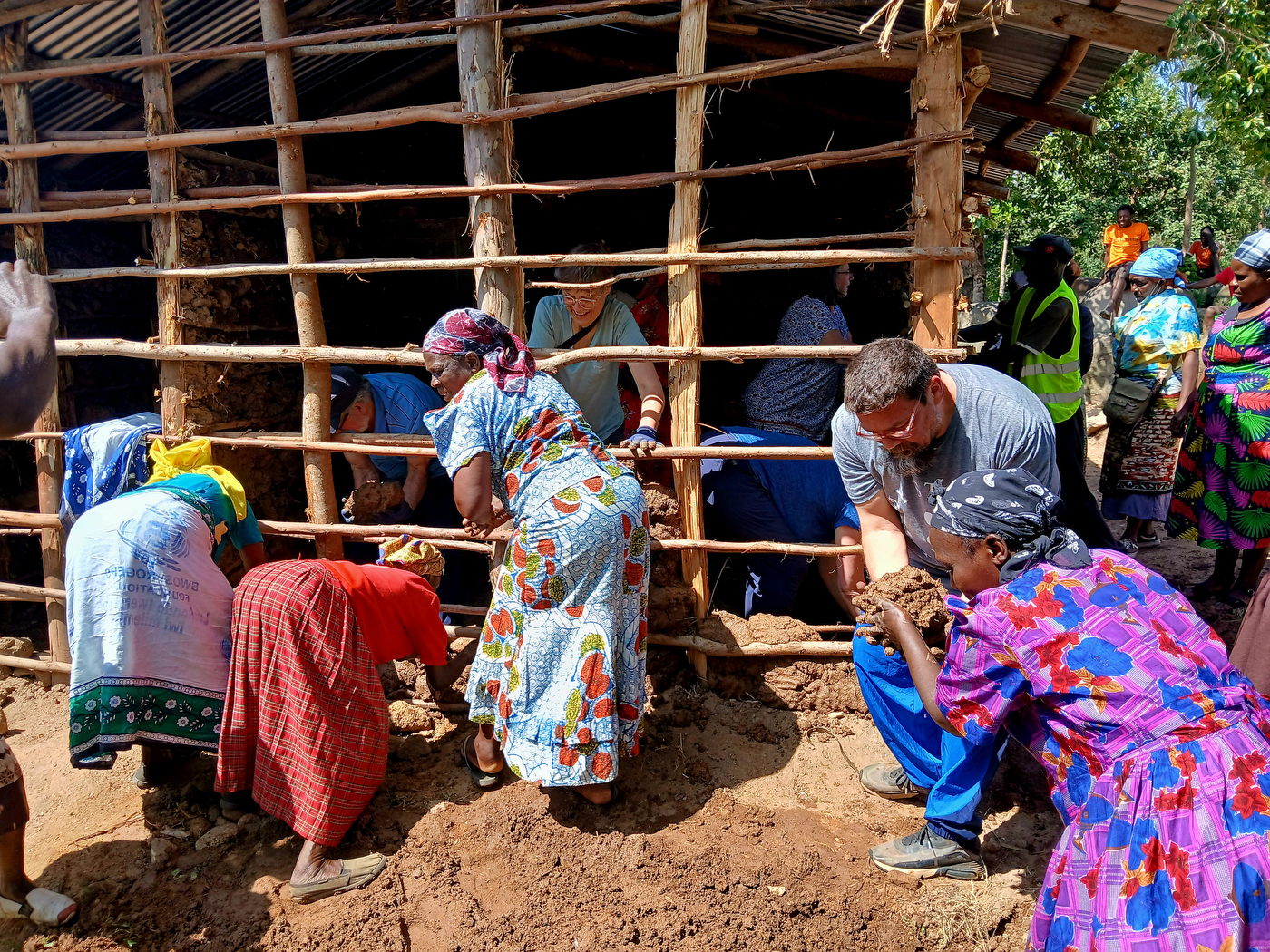
As Philip pulled the van off the dirt road and onto Phanice’s land, we were met with singing and shouting and dancing and garlands ready to be draped around our necks. The entire widows group and their children and grandchildren and neighbors were there to greet us. The singing and shouting and dancing continued as we filed out of the van and were led to the home which, in their excitement, was nearly completed in its first mudding. One wall remained unfinished that we would ceremonially construct.
A pile of mud took up the center of one room. Pastor Phanice bent down and expertly rolled a mud brick from the pile and handed it to Karen to put in place. Phanice rolled another mud brick and handed it to Nancy. Another brick was rolled and handed to Mary, then Stan, then Jason, and finally to me. The bricks kept coming, and we kept placing them. Eventually I stepped back to take pictures, and that is when Rebah asked me if I wanted to see how the mud was made.
She took me behind the house where a barefoot young man was dancing in the mud. He danced and stomped, then paused to use a jembe to pull the mud to the side of the pit where the women were ready to roll it and carry the bricks to the house. Water was poured on the dirt and the young man danced and stomped to make more mud. “Do you want to try it?” Rebah asked, handing me the jembe. I jumped into the mud pit and started pulling mud with the heavy tool. “Like this?” I asked, and, “Am I doing it?” To which Rebah replied, “You are trying,” and we all laughed together.
By the time I got out of the mud, the final wall on Pastor Phanice’s home was complete. Depending on the weather, the mud would need about two weeks to dry, and then another layer would be added by throwing mud at the walls to fill in the gaps and cracks, and soon enough it would be ready for Phanice to move in.
The women began singing and dancing again and we all joined in before sitting down under some trees. Rebah welcomed us all, and each of the women in the widows group greeted us and introduced themselves. We reciprocated our greetings and introductions. Prayers were prayed.
More songs were sung. We showered Phanice with “kedogo zawadi” — small gifts as housewarming presents, plus a mattress, blanket, and cooking pot. We then showered the entire widows group with gifts that our friends in the U.S. had sent along with us for the women and children — things like reading glasses, underwear, band-aids and balloons and Tylenol, plus a large bag of maize. The women then gave us gifts — a live chicken and a large bunch of bananas.
No gathering in Kenya is complete without “tea” (which may be a cup of tea, or it may be a four-course meal). A pitcher of water and a bowl would materialize, and the women would come to us and pour water over our hands as we prepared to eat together. That day we had a feast: ugali, potatoes, rice, chapati, sukuma wiki, chicken, beef stew, and lentils, followed by a coke. The generosity of the women whom we had come to serve seemed to far outweigh what we had to share.
It always seemed too soon to depart and head for home. Every moment with these women who were so grateful, so generous, so loving, so kind, so joyful, was a moment to cherish forever. But just as we had all piled into the van to come that morning, we all piled in again to go. Plus a live chicken, a large bunch of bananas, and anyone else who needed a ride home. That day it was Robby, one of the widows, who was a graduate of FTC. She lived nearby and wanted us to see her home, to take a picture with those of us who had traveled so far, to have us stand in her living room and see how good God had been to her, to see that God loves widows and cares for them in their distress.
If you are starting to think that our van was getting quite full at this point as we picked up more and more passengers (and chickens and bananas!), you are both correct and incorrect. Correct, because every seat was occupied (sometimes double-occupied!). But incorrect because of the Kenyan saying: “There is always room for one more.” There was always room for one more in the home, in the van, in the church pew, on the back of the motorbike. There was always room for another song, another prayer, another handshake, another greeting, another smile, another hug with my cheek placed against your cheek. And there was always room for one more dinner invitation.
In America we say, “Build a bigger table,” but in Kenya you just sit closer and hold each other tighter. You say “jambo” (hello!) and “jambo tena” (hello again!), because one greeting just isn’t enough.
One of the Friends leaders we met in Kenya said, “America is nowhere near here, but you came because of your hearts.”
It was true. We came because God calls us over and over in the Bible to care for widows and orphans and the vulnerable. It was on our hearts to show kindness in a practical way, to be the hands and feet of Jesus.
But it was also true that kindness was showered on us from the moment we stepped on African soil. From Milly’s smile while she cooked for us to Philip slowing down the van so we could take pictures, from Everlyn’s language lessons to Rebah’s encouraging “you’re trying,” from Wycliffe’s patient teaching style to Eric’s presence as our night watchman, from the widows’ joyful singing to the deputy governor’s invitation to dinner, from always being treated like there was room for us, the kindness that we gave returned to us tenfold.
As Luke 6:38 says, “For if you give, you will get! Your gift will return to you in full measure, pressed down, shaken together to make room for more, and running over. Whatever measure you use to give — large or small — will be used to measure what is given back to you.”
In Kenya, I discovered there is always room for more kindness, and the greatest kindness may just come in the form of a cup of tea and a bunch of bananas gifted by a grateful widow.
Practicing Kindness as a Quaker Path, Kelly Kellum
John Woolman Discovers Kindness and Changes Friends Forever, Michael Jay
At the Altar, Michael Sherman
Blessed Are the Kind, J. Brent Bill
Friends Bringing Hope, Katie Hollingsworth
Guilt . . . or Grace, Bill Eagles
In Sickness and in Health, Tom Mullen
Bubbles, Emily Provance
Kindness: A Biblical and Practical Exploration, John Sirengo
On Letting our Lives Speak: Remembering the 1985 World Gathering of Young Friends, Paul Anderson
I solemnly assure you, as I did before, that those who indulge in such things will never inherit God’s kingdom. The Spirit, however, produces in human life fruits such as these: love, joy, peace, patience, kindness, generosity, fidelity, tolerance and self-control — and no law exists against any of them.— Galatians 5:21–22, J. B. Phillips translation
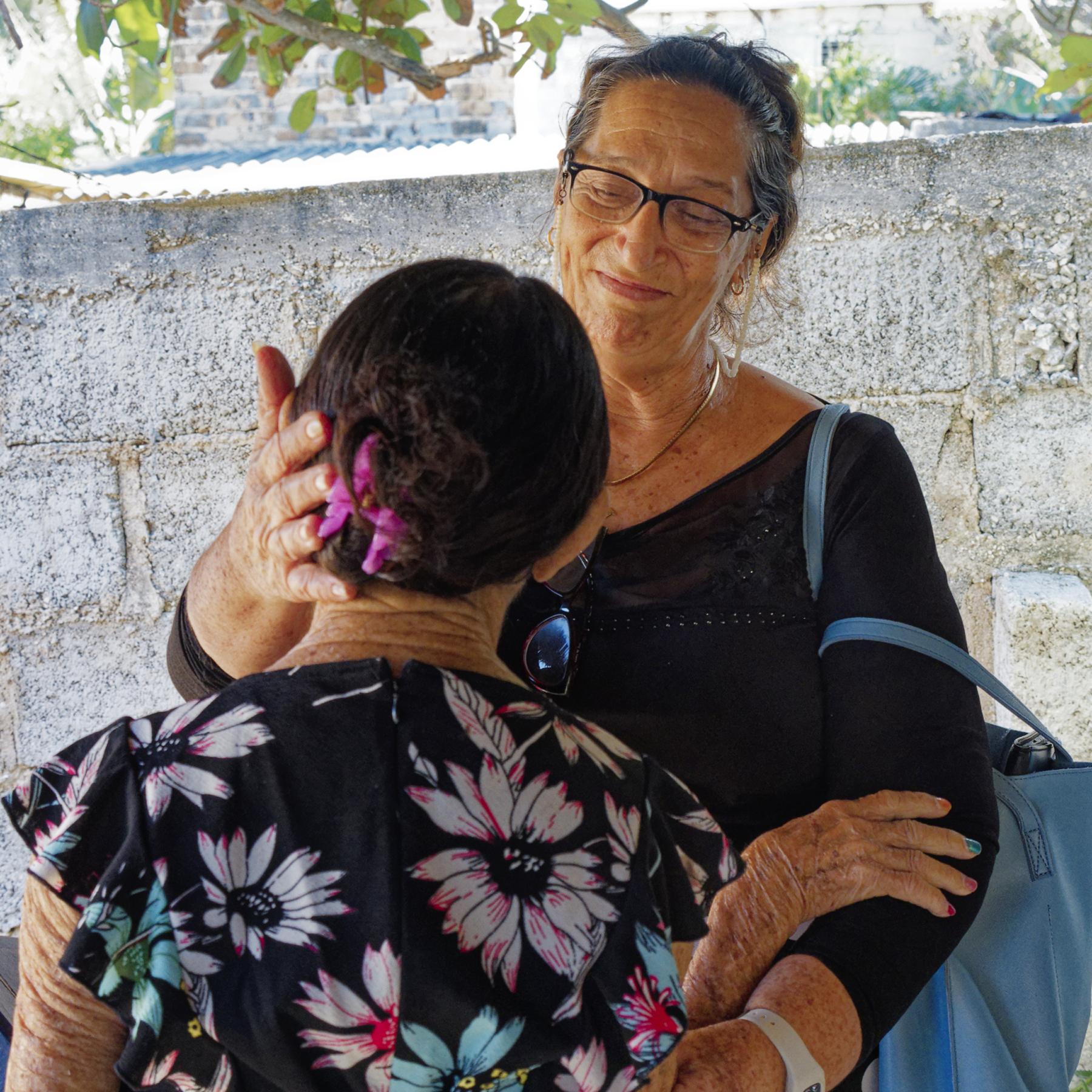
The face of Adolfina Nuñez Muñiz, the Cuban pastor who appears on the cover of this issue of Quaker Life, radiates kindness: some alloy of compassion, care, love, and concern. Kindness, a relative of the word kin, is a foundational word, one of those words that is what it says, rather than a word assembled from multiple ideas. We know kindness when we see it or feel it or do it more easily than we know it by dictionary definitions — though dictionaries nevertheless offer definitions. Many of them define kindness along the lines of “the quality of being gentle, caring, helpful, attentive.” Or, to paraphrase the theologian Howard Thurman, “the building blocks for human society and for individual well-being are the fundamental desire to understand others and to be understood. Every person wants to be cared for, to be sustained by the assurance of the watchful and thoughtful attention of others.”
Two of our essays in this issue take on the labor of defining kindness, and the special attraction it has within the circle of Jesus’ followers. Kelly Kellum considers the relationship between the traditional Quaker testimonies and our conscious efforts “to alleviate suffering and promote wellbeing in ourselves and others.” Beyond the level of person-to-person interaction, Kellum writes, kindness intersects with shalom — the establishment of God’s peaceable kingdom upon the foundation of justice and equity in human and societal relations. In line with that idea, John Sirengo looks at literature ranging from theology to social psychology to ecology to find that kindness has a central role in fostering human flourishing.
Some of our authors write about the way in which kindness might change the world —or has. Michael Jay reminds us that one of John Woolman’s first intimations of God’s love for ALL of creation came through Woolman’s childhood cruelty to a family of robins. His anti-slavery work, Jay writes, is simply an expansion of his insight into God’s kindness to all of creation: “Because Woolman was able to repent of his own cruelty, and because he recognized that cruelty to animals is the mark of a wicked person, he was able to see that society was cruel and to speak against this cruelty. Because kindness is the mark of a just person, justice cannot be cruel.”
Brent Bill points out that kindness is not simply a warm, fuzzy feeling without power, as we so often believe, but that kindness is risky and subversive, counter-cultural — and replete with love. Michael Sherman agrees that “we have a tendency to let kind and gentle become amalgamated into a soup of niceness. But they are not the same thing. Some of the kindest things that have happened to me were not particularly nice or pleasant, but they were definitely kind. A clear ‘no’ can be one of the kindest things.” He goes on to point out that we can use the stones we carry as weapons or building blocks and that using them for building is kinder not only to others, but to ourselves. Bill Eagles writes about how the kindness of others may offer grace to the world in difficult times.
Some of our authors describe what kindness looks like— the actions and attitudes of kindness. Katie Terrell Hollingsworth writes about her volunteer service in Kenya with the Quaker group Friends Bringing Hope, and Rural Service Programme. It’s true that she and the rest of the group travelled to Kenya with gifts and offers of service, she writes, but “the generosity of the women whom we had come to serve seemed to far outweigh what we had to share.” In his book A Very Good Marriage, Tom Mullen wrote about how the vow to love each other “in sickness and in health” was woven throughout the years of his marriage to his wife Nancy. Reading his account, I am struck by the deep kindness with which they acted toward each other, from the very beginnings of their relationship.
Emily Provance writes about witnessing an interaction between four children, two with bubble wands and two without. She runs through anticipated scenarios in her mind: cruelty, whining, one child’s emotional meltdown. But instead—playfulness and kindness. Which, she thinks, is quite possibly the way the world is meant to be.
In writing about the World Gathering of Young Friends held at Guilford College forty years ago, Paul Anderson also recognizes the way in which that group of disparate Young Adults was held together by kindness—by the attention and willingness to listen of both leaders and participants. The words of that 1985 epistle might describe all of us hoping that kindness will come to fruition in our lives:
“We seek as people of God to be worthy vessels to deliver the Lord’s transforming word, to be prophets of joy who know from experience and can testify to the world, as George Fox did, ‘that the Lord God is at work in this thick night.’”
