


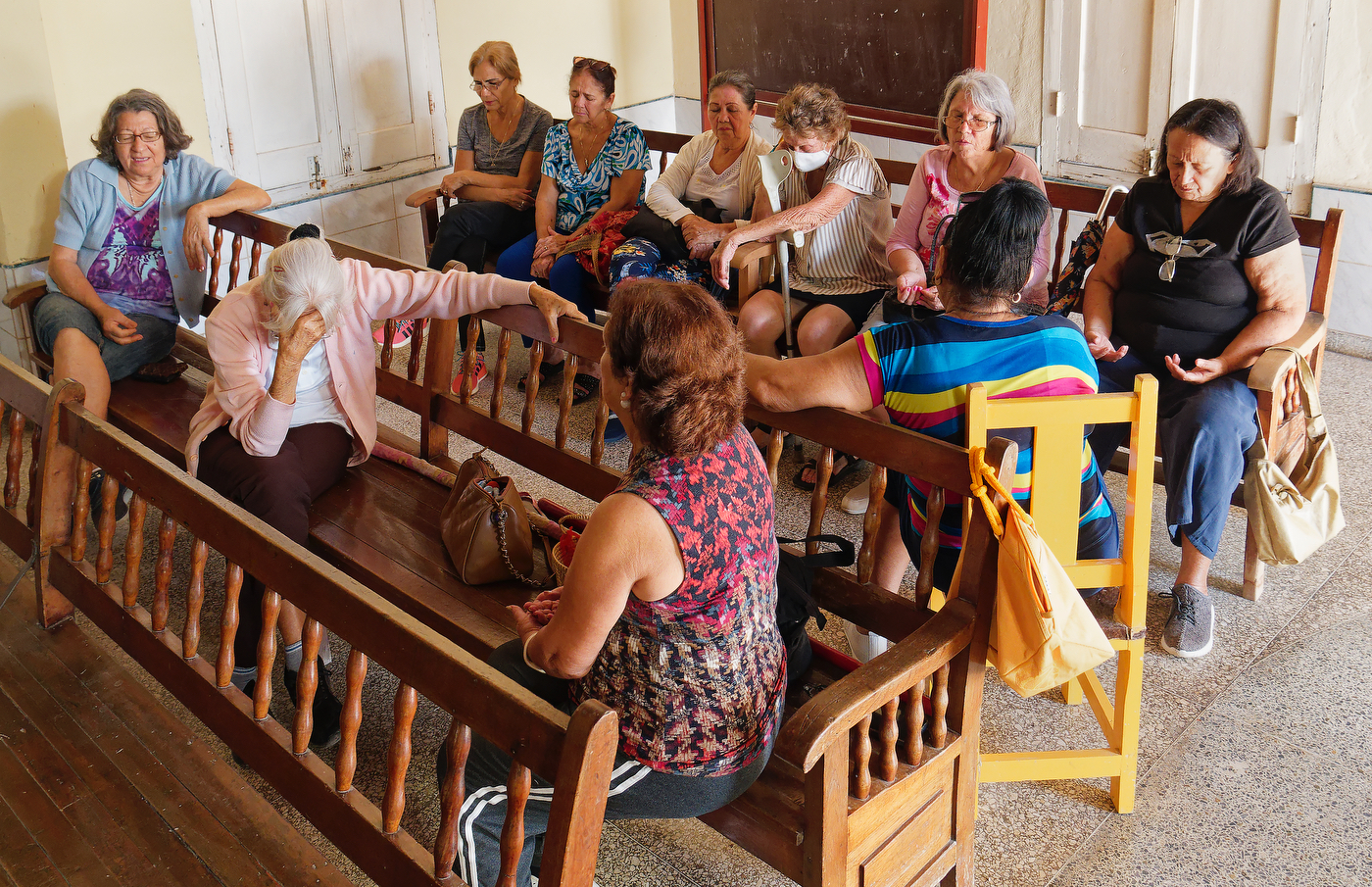
The first Quaker missionaries arrived in Cuba from Iowa Yearly Meeting in the early 1900s. When the missionaries arrived in Cuba, Cuba was an island heading to prosperity and it was fertile soil for a missionary effort. They soon established churches and schools and celebrated their first Yearly Meeting sessions in 1927. The missionaries landed in a port city named Gibara, and this is where our tale begins.
In Gibara, in the early 1900s, there lived a young woman named Maria Luisa Cuesta. When she heard that there were Americans who had arrived in Cuba and wanted to begin a mission, she was curious and attended their first meeting for worship. When she shared those memories much later, she recalled that the group that first met was small. Eventually she married and had a daughter, Margarita Soler Cuesta, and raised her in the Friends Church in Gibara. That daughter also got married and had a daughter, Maria Margarita Aguilar Soler, and that daughter did the same, though she had three children: Mariluz Zaldivar Aguilar, Daniel Saldivar Aguilar, and Elio David Zaldivar Aguila. The last, David, is a Cuban Quaker who now lives in Richmond, Indiana.
I have worked closely with David in my work with Hispanic Friends in Richmond, and he’s told me the story of how he got here and the sacrifices that his ancestors went through to give him a rich Quaker heritage. All three of his great-grandmothers, his grandmother, and his mother, went through the Communist Revolution in 1958. During this time the government seized all church property and closed the churches.
David says, “My ancestors never stopped worshipping despite the persecution against people of a religious background. Despite being threatened with being thrown into prison, or having opportunities for personal advancement taken away, such as a job, or a promotion, or a superior position, they always prioritized their faith.” He has heard that at some point in the 1960s, before he was born, the Gibara Friends Church hit its lowest point—only five people would meet for worship. Yet some of the children of those five faithful Friends are still members in the Cuban Friends churches today.
David recalls that he himself suffered government harassment for being a Christian in his childhood schooling. School authorities would threaten him with punishment, such as taking away his honors and privileges for being a good student. His father and mother would be threatened with having their jobs taken away. Despite all this, David’s mother would say, “they can take everything away from us, but in this house we will always go to church, because this is what we do in this family.”
The situation in Cuba has slowly been changing. Most of the church buildings that were taken by the government have returned to the ownership of Cuba Yearly Meeting, as well as two of the school buildings in Puerto Padre and Gibara. Both churches now use the school buildings to provide visitor lodging and services, which earns income for the Friends churches. Cuba’s government now allows some degree of religious freedom. The Quaker church in Cuba saw some growth after the government allowed for religious freedom. Yet the church still suffers from the decades of persecution.
There are many privileges that the church in Cuba does not enjoy—for example, they can’t build new church buildings, but are only allowed to rebuild the buildings they owned before the Revolution. Rebuilding has been a big focus of Cuba Yearly Meeting. Churches in Cuba do not enjoy the non-profit status that they have in the United States, but are treated by the government in the same manner as a private business, with the same responsibilities and obligations. Yet the Friends Church in Cuba does not stop, but continues to push through and to build.
Quakers in Cuba are always grateful for the Friends who remained faithful when persecution was most severe.
Un cuento de fidelidad
Los primeros misioneros cuáqueros llegaron a Cuba en 1927, provenientes de la Junta Anual de Iowa, a principios del siglo XX. Cuando los misioneros llegaron a Cuba, Cuba era una isla en vías de prosperidad y un terreno fértil para la labor misionera. Pronto establecieron iglesias y escuelas, y celebraron sus primeras sesiones de la junta anual en 1927. Los misioneros desembarcaron en una ciudad portuaria llamada Guibara, y aquí es donde comienza nuestra historia: en Guibara vivía una joven en la década de 1900 llamada María Luisa Cuesta. Cuando supo que había estadounidenses que habían llegado a Cuba y querían comenzar una misión, sintió curiosidad y asistió a su primera reunión de culto. Más tarde compartió esos recuerdos y recuerda que el grupo que se reunió inicialmente era pequeño. Posteriormente se casó y tuvo una hija, Margarita Soler Cuesta, a quien crio en la Iglesia de los Amigos de Guibara. Esa hija también se casó y tuvo una hija, María Margarita Aguilar Soler, y esa hija hizo lo mismo, pero esta vez con tres hijos: Mariluz Zaldívar Aguilar, Daniel Saldívar Aguilar y Elio David Zaldívar Águila. Entre ellos se encuentra David, un cubano cuáquero que ahora reside en Richmond, Indiana.
El cuenta la historia de cómo llegó aquí y los sacrificios que hicieron sus antepasados para transmitirle una rica herencia cuáquera. Sus tres bisabuelas, su abuela y su madre, vivieron la Revolución Comunista de 1958. Durante este tiempo, el gobierno confiscó todas las propiedades de la iglesia y las clausuró. David dice que mis antepasados nunca dejaron de adorar a pesar de la persecución contra las personas de origen religioso. A pesar de ser amenazados con ser encarcelados o con quitarles oportunidades de progreso personal, como un trabajo o un ascenso a una posición superior, siempre priorizaron su fe. Compartió que en algún momento de la década de 1960, antes de que él naciera, la Iglesia de los Amigos de Guibara llegó a su punto más bajo, con solo cinco personas reuniéndose. Algunos de los hijos de esos cinco fieles Amigos aún son miembros de las Iglesias de los Amigos.
David recuerda que él mismo sufrió acoso gubernamental en su infancia por ser cristiano en la escuela. Lo amenazaban con castigos como quitarle sus honores y privilegios por ser un buen estudiante. Su padre y su madre eran amenazados con quitarles el trabajo, a pesar de todo esto la madre de David decía, nos pueden quitar todo, pero en esta casa siempre iremos a la iglesia, porque eso es lo que haceamos en esta familia.
La situación en Cuba ha ido cambiando poco a poco: la mayoría de los edificios de la iglesia han vuelto a ser propiedad de la Junta Anual de Cuba, al igual que dos de los edificios escolares en Puerto Padre y Güibara. Actualmente, estos edificios se utilizan para servicios de alojamiento. Cuba experimenta una política de libertad religiosa más relajada. La Iglesia Cuáquera en Cuba experimentó cierto crecimiento después de que el gobierno permitiera la libertad religiosa. A pesar de ello, la iglesia aún sufre las consecuencias de muchos años de persecución. Existen muchos privilegios de los que la iglesia en Cuba no disfruta; por ejemplo, no puede construir nuevos edificios para la iglesia; solo se le permite reconstruir los edificios que eran de su propiedad antes de la revolución. La reconstrucción ha sido un tema central de la Junta Anual de Cuba. No existe un estatus legal para las instituciones religiosas; el gobierno trata a la iglesia como si fuera una empresa privada. La Iglesia de los Amigos en Cuba no se detiene; sigue adelante y avanza.
Los cuáqueros en Cuba agradecen a los pocos amigos que se mantuvieron fieles.
Faithfulness in Cuba, Karla Jay and David Zaldivar
Sabbath Play, Emily Provance
Living Water, Marlene Pedigo
First Steps Toward Repair, Gordon Bugbee
Faithful Across Continents, Furaha Kafuze and Charlotte Stangeland
Lord, Keep Me Faithful, Pam Ferguson
Faithfulness as Risky Obedience, Kelly Kellum
Living in the Life and Power, Colin Saxton and Daniel J. Kasztelan
Therefore be faithful to God and mind that which is committed to you, as faithful servants laboring in love, some threshing, some ploughing and some to keep the sheep . . . all to watch over one another in the Spirit of God. — Letter #16, 1652, George Fox
This edition of Quaker Life revolves around the idea of faithfulness, another one of the fruits of the Spirit Paul enumerates in Galatians 5:22–23. Our essays run from keeping the church community alive and well, as in Cuba, to deepening one’s own spiritual core through commitment and community.
Karla Jay and David Zaldivar tell the story of Cubans who kept meeting for worship in their churches even during the periods of strongest government persecution, and thereby kept their churches in their possession until, eventually, the government relaxed its strictures. These days, they build their church communities by caring for one another—physically, emotionally, and spiritually—and by rebuilding churches and centers that the government took over, let fall into ruins, and then gave back.
Emily Provance writes about the importance of sabbath—including play—to allow our minds to function for long-term problem solving, and not simply crisis intervention. She writes about our need to balance awareness of the world’s suffering with the sabbath times required for us to be at our imaginative and compassionate best when we face that suffering, as faith calls us to do.
In an excerpt from her book, Simple Joy, Marlene Pedigo writes about early Friends women who experienced a call to ministry, and the sense of disobedience and reproof that many of them experienced if they delayed or ignored that call. She goes on to write about experiencing that same call herself, in the Cabrini-Green neighborhood of Chicago, and especially about the inner, spiritual baptism necessary to be able to answer that call.
Gordon Bugby writes about the leading that he and his wife Mary Zwirner have followed, to visit among Native Americans and Friends congregations in Oklahoma and elsewhere. His story introduces us to several layers of faithfulness: the desire of nineteenth century Friends “to uplift embattled Native people” by bringing both education and the gospel, even as many of those Friends’ actions contributed to the loss of Native culture and Native land; the continuation of Friends’ practice among some small number of indigenous people educated through those Friends Missions in Oklahoma and elsewhere; the willingness of Friends in New England Yearly Meeting to examine the role that their Yearly Meeting played in Native American boarding schools and to explore how reparations might be made; and the willingness of the authors to follow their own leading and build relationships with the indigenous people harmed by Friends’ participation in the boarding school system.
Furaha Kafuze, an Iowan originally from Congo, tells Charlotte Stangeland about her faithfulness to God in prayer, and God’s faithfulness to her in her life as a refugee, through times of flight and through times of rescue. Pam Ferguson writes about her friend, Walter, and her wonder about why someone whose life seemed so clearly faithful would continue to pray every day, “Lord, keep me faithful.” As she grows closer to the age Walter was when they met, however, she better understands the prayer. The suffering of the world can so easily overcome the hope of faith. Walter’s prayer, combined with the illustration of his life, continues to teach her that prayer is necessary for upholding the heart in following Jesus.
Finally, Colin Sexton and I enter into an extended conversation about his recent lecture on living in the Life and Power of God and how that spiritual pursuit could make Friends more relevant to people searching for solid ground in tremulous and fickle times like these.
Faithfulness is always specific to each believer’s time and space, yet the core of faithfulness—an extended conversation between individual and God, community and God: call and response, response and call—seems common to the faithful across gifts and locations.
