
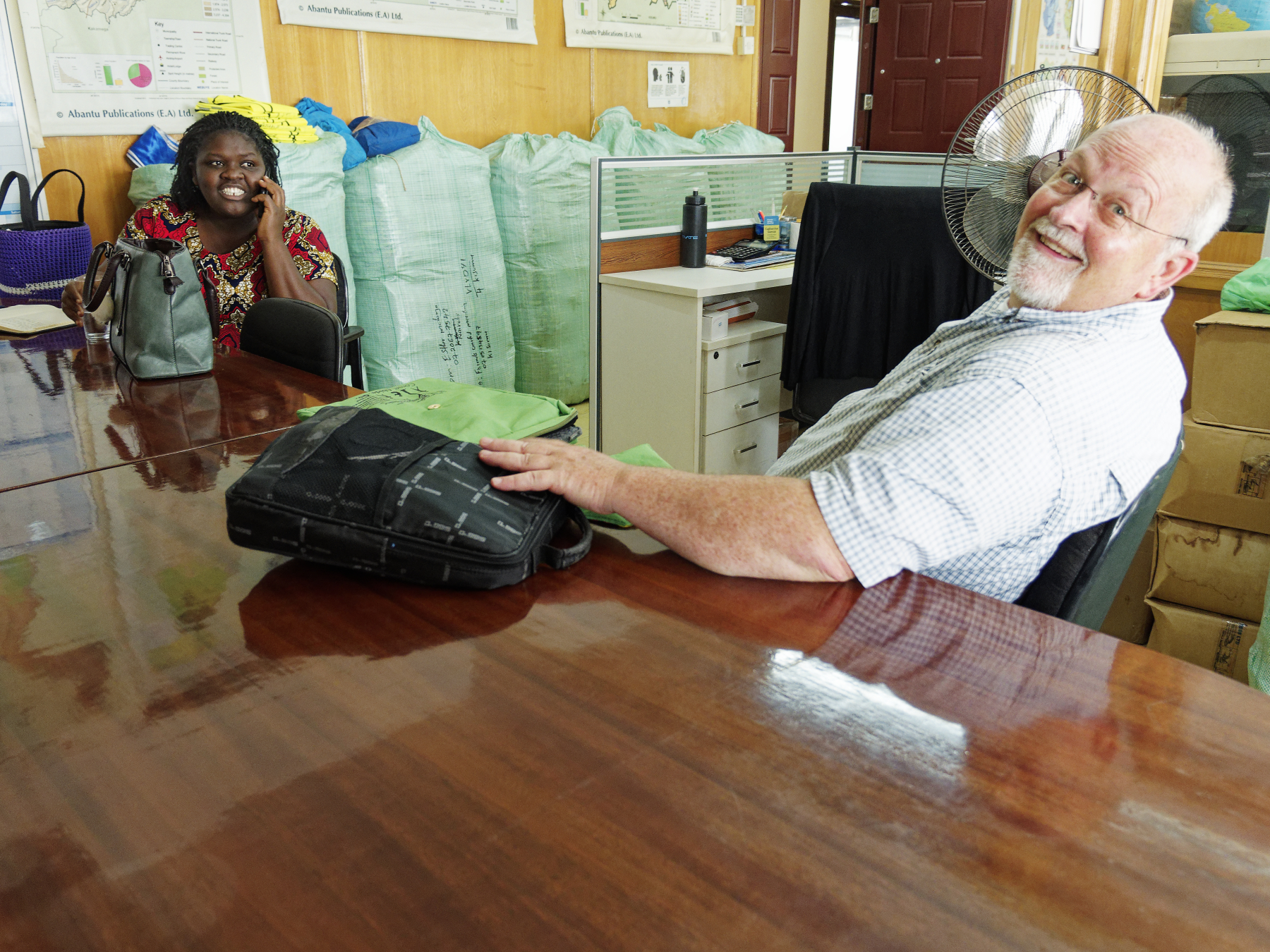
Several weeks ago, Kelly Kellum gave his last report to the General Board of Friends United Meeting. As Kelly leaves the office, and an interim team steps forward to carry on the work of Friends United Meeting, we believe that last report is a fitting farewell.
Kelly Kellum
Eight years ago, when I began my service as General Secretary of Friends United Meeting, I opened my first report to the General Board with this prayer:
Gentle me,
Holy One,
into an unclenched moment,
a deep breath,
a letting go
of heavy expectancies,
of shriveling anxieties,
of dead certainties,
that, softened by the silence,
surrounded by the light,
and open to the mystery.
I may be found by wholeness,
upheld by the unfathomable,
entranced by the simple,
and filled with the joy
that is You.
—Ted Loder, from Guerrillas of Grace
At that time, the prayer was an acknowledgment of my own anxieties and the weight of the expectations on me. I was stepping into a role that carried significant responsibility. While I was honored and excited by the opportunities entrusted to me, I was also deeply aware of my limitations, of my abilities, and of how the burden of stewarding this work could potentially wear on my soul and rob me of hope, wonder, and joy. The prayer reminded me that faithful leadership is not always about having all the answers. It is about releasing the illusion of certainty, remaining open to God’s leading, and trusting that my service and work ultimately rest in hands far greater than my own.
I find myself returning once again to this prayer as I wrap up my service to Friends United Meeting. This, too, is a time of high anxiety, both in the world around us and within our own FUM community. Yet the invitation remains the same: to relinquish the illusion of certainty, to become tender to God and to one another, and to trust that the future ultimately rests not with us and our wisdom, but with the One whose still, small voice speaks to our condition.
Serving Friends United Meeting has been one of the greatest privileges of my life, and I am deeply grateful to Friends who entrusted this work to me. There have been many times over the last eight years I have found myself in a particular place or moment and had to pause to appreciate the honor of being there. Whether participating in a pastoral care trip to Ramallah and joining Christian pilgrims on the Palm Sunday march into Jerusalem, visiting churches under trees in northern Kenya, or standing with Cuban Friends watching the sun rise in Gibara to commemorate the arrival day of Quaker missionaries, I often found myself thinking, “It is an honor and a privilege to be here and to serve this community.”
This work has taken me to remarkable places, introduced me to many inspirational people, and along the way I have witnessed remarkable faithfulness, extraordinary generosity, courageous leadership, and a deep commitment to Christ and Christ’s work in the world.
While I appreciate the need for renewed vision, new strategic plans, governing structures, and leadership, I want to offer this caution—do not give away too easily the things that make Friends United Meeting special. We hold a unique place within the Religious Society of Friends, and we have a distinct identity and calling that is uniquely ours.
Historically, Friends United Meeting has been steward of the Orthodox Friends tradition. This heritage makes us both distinctly Christian and distinctly Quaker. These are not competing identities. Rather, they are inseparable to who we are.
Our faith in Jesus Christ shapes how we understand and strive to live out our Quaker faith and testimonies in the world. Our commitment to peace, integrity, equality, and any other spice you want to add to it does not emerge apart from our faith. Rather, these testimonies find their source and meaning in our relationship with Christ and our commitment to follow His teachings.
This unique witness remains vitally important.
Within the broader family of Friends, there are pressures from different directions. In some places, there is a tendency to adopt forms of Christianity that, while sincere and well-intentioned, become increasingly disconnected from the distinctive traditions, practices, and spiritual insights that have shaped Friends for generations. In other places, there is a tendency to distance ourselves from the Christ-centered faith that has historically grounded the Quaker movement.
As we look toward the future, I believe Friends United Meeting has an important responsibility to preserve, strengthen, and share this distinctive witness. The world does not need Friends United Meeting to become something else. The world needs Friends United Meeting to become more fully what it has been called to be.
One of the greatest gifts of Friends United Meeting is that we are a global fellowship.
One of our core ministry priorities is Global Partnership. We are not a North American mission agency. We are a global community of Friends brought together to steward ministries, deepen relationships, broaden our understanding of one another, and carry forward the mission and work of Friends United Meeting.
What makes Friends United Meeting unique among Quaker organizations is that global partnership is central to our DNA. It shapes how we understand ourselves, how we make decisions, how we allocate resources, and how we engage in ministry together. Our commitment to global partnership is reflected in our staffing strategies and our governance structures.
I remember a time when I was serving as Clerk of Friends United Meeting and presiding over board meetings in East Africa. During one session, a courageous member of the board asked a pointed question: “When Friends United Meeting comes to Africa to host board meetings, are these meetings merely ceremonial, or are we Africans truly part of the decision-making process?”
It was an important question, and at the time I had to confess that these gatherings were often more ceremonial than substantive. While valuable conversations took place, many of the decisions shaping the future of Friends United Meeting were still being made in Richmond, Indiana, rather than in East Africa.
That question has remained with me.
Our commitment to authentic global partnership begins with the recognition that the wisdom, gifts, experiences, and spiritual insights needed for the future of Friends United Meeting are not formed only by those in North America, but shaped through global discernment and a commitment to listening to one another as we seek God's guidance together.
Another distinguishing aspect of Friends United Meeting is our commitment to serve vulnerable communities.
We are not called to serve in easy places.
From Ramallah in the West Bank, where families live under the daily realities of military occupation; to Cuba, where Friends continue their ministry under the pressures of sanctions and isolation; to northern Kenya’s Samburu and Turkana regions, where communities experience the disproportionate effects of climate change and environmental stress; to the south side of Belize City, where poverty and limited educational opportunities continue to affect the lives of children and families—it is into these places that Friends United Meeting has been called to serve.
These are communities that are often marginalized because of poverty, geography, environmental pressures, conflict, war, or violence. Yet time and again, Friends United Meeting has chosen to stand alongside those whose voices are often unheard and whose needs are often overlooked.
This commitment reflects the very heart of the Gospel. Jesus reminds us that our faithfulness is revealed in how we respond to the most vulnerable among us:
“Truly I tell you, whatever you did for one of the least of these brothers and sisters of mine, you did for me.” (Matthew 25:40)
I earnestly believe that the future of Friends United Meeting continues to be shaped by this commitment. Friends want their lives, their dollars, their service to count. When we stand alongside vulnerable communities with the love and grace of Christ, we live out our faith in ways that are both tangible and transformative.
Last year, I had the opportunity to participate in a celebration honoring young women in Kenya who had graduated from secondary school through the Girl Child Education Program. There was cake, celebration, and much joy, but what moved me most was listening to the aspirations of these young women.
One after another, they spoke about their hopes for the future. They wanted to become teachers, nurses, businesswomen, IT specialists, and doctors. As I listened, I was reminded that many of these opportunities would not have been possible without the commitment and generosity of Friends who believed in them and invested in their future.
Because of who we are and because of what we are called to do in the world, Friends United Meeting has a unique and timely prophetic voice.
It is a voice that I earnestly believe the world needs right now.
• A voice willing to speak truth with humility.
• A voice willing to stand alongside those who suffer.
• A voice willing to confront injustice while extending grace.
• A voice willing to proclaim, as Friends have proclaimed for generations, that there is One, even Christ Jesus, who can speak to the condition of the world.
This prophetic witness is not separate from our ministry. It is an expression of it.
For this reason, communication must be understood as more than telling Friends about Friends. At its best, communication is ministry. It is one of the primary ways we bear witness to the hope that resides within us, and that we invite others into the transforming work of Christ in the world. When we tell the stories of lives changed through education, communities strengthened through partnership, peace built through reconciliation, and faith sustained through adversity, we are proclaiming that God continues to be at work among us.
In a world often overwhelmed by division, fear, and despair, Friends United Meeting has an opportunity and a responsibility to communicate a different story: a story of hope, faithfulness, reconciliation, and the enduring presence of Christ.
As I conclude this chapter of service, I leave with deep gratitude. Thank you to the staff with whom I have served. Thank you to board members who have given countless hours in support of this ministry. Thank you to ministry partners, volunteers, donors, and Friends who have been such an inspiration and blessing to me.
My prayers and my love will remain with this community which I have called home. It has been my intention to leave well. Leaving well means relinquishing. To that end I have been reflecting on these words from Issac Pennington.
Give over thine own willing;
give over thine own running;
give over thine own desiring
to know or to be anything;
and sink down to the seed
which God sows in the heart,
and let that grow in thee,
and be in thee,
and breathe in thee,
and act in thee,
and thou shalt find by sweet experience
that the Lord knows that,
and loves and owns that,
and will lead it to
the inheritance of life,
which is its portion.
Grace and Peace!
—Kelly Kellum