

Mama, can you give me Roly Poly?
Roly Poly, beloved stuffed sock rabbit, sits just far enough in from the edge of the kitchen counter that Gardenia can’t reach her. Her tiny fingers are stretching, and she looks at me with expectation. All I need to do is push the bunny half an inch closer to her.
I’m washing dishes, though, and the moment it takes to finish a bowl and rinse my hands gives me time to think. Does she actually need me to help? Would it be better to point out something she could use as a step stool, or encourage her to push up on her toes?
Even though this line of questions is snaking only through my inner dialogue, Gardenia does not approve.
Mama, I no reach Roly Poly. You help me?
In Aristotelian ethics, a virtue sits at the golden mean between two vices. Take courage, for example. We tend to think of courage as the end goal, evaluating ourselves on how more or less courageous we are. Aristotle, on the other hand, sees a spectrum from cowardice to recklessness with courage balanced in the middle. The goal is not to max out the virtue but rather to have the proper amount of forward drive: not shying away from hard and scary things, and also not taking unnecessary risks.
The same is true of mercy. Too much and too little are both bad. Too little is hard-heartedness, which I find hard to imagine. I hope my heart is always a soft place for Gardenia to land.
Too much mercy, though . . . well. Gardenia is easy to indulge. She is a light burden to bear on my shoulders. It costs me nearly nothing, most of the time, to fetch her toy when she doesn’t feel like getting it herself, to solve her problems rather than asking her to solve them herself.
It costs me nearly nothing to indulge her. It costs her everything: her opportunities for development, for learning to make mistakes and recover from failure, for becoming the capable and confident woman God is making her to be.
Mama, why you no help me?
I am helping, but she can’t see that. “My hands are in the sink,” I say, which is technically true although I am watching her stretch rather than washing dishes. “If you bring that little crate over, you can stand on it and reach Roly Poly for yourself. I believe that you can do this.”
The first line of the book How to Talk so Little Kids Will Listen is this: “The way we talk to children will become their inner voice.” The whole thing is fantastic, but the first line alone was worth the price of the book.
The image of my words ringing in my children’s heads long after I’m gone haunts me. In a moment of frustration, something springs to mind that I want to say. For me such words are transient, yet the words I speak angrily to my children, or sentences I speak that express my sense of their limitations or lack of capability—these could become part of their inner world: words that they hear accusing or rejecting them so deeply that they cannot separate my words from their very selves.
When writing on how we should treat our persecutors, Paul says we should bless them. Bless, and do not curse. If that’s how I should speak to someone treating me unjustly, how much more should it be the standard for how I speak to my children
Why I no help my sweetheart? Because I’m pretty sure she can get it, actually, and I need to say that out loud. I need to bless her by telling her who she is to me.
You are my big strong girl, Gardenia! Reach up, up, up!
No, Mama! I am little. My brother is Big Guy and I am Little Girl.
You are smaller than George, but you’re much bigger and stronger than you used to be! Look, your fingers are touching Roly Poly. See if you can move her a bit.
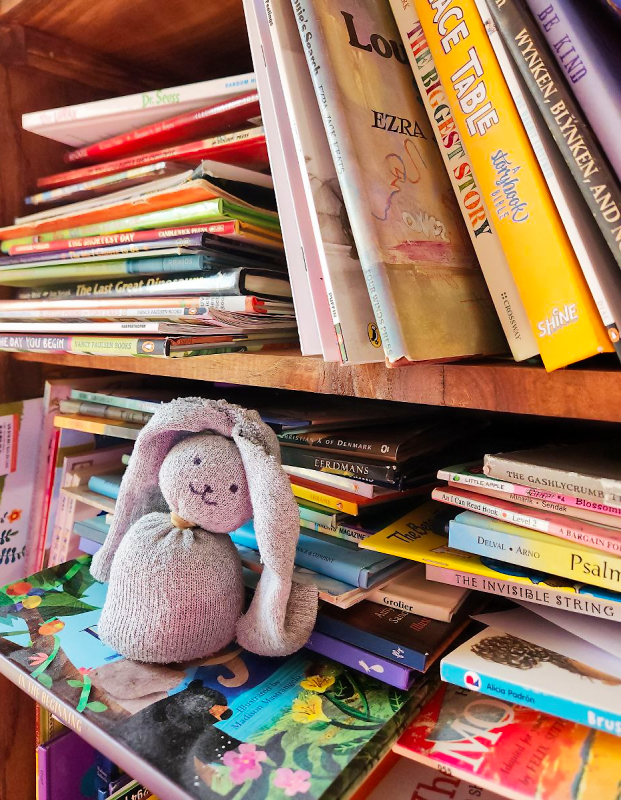
Roly Poly got her name because she’s essentially two spheres. She came home with us as a craft made at a toddler group. You, too, can have a Roly Poly. Take a sock and pour a cup of uncooked rice in it, and use a rubber band to secure the rice at the toe of the sock. Pour in ¾ a cup of rice and use another rubber band to secure. Cut the top of the sock down the middle so that it falls like droopy rabbit ears and use a marker to draw some features.
It took Gardenia two days to explain to me that the bunny’s name is Roly Poly. She whispered the name, yelled it, showed me the rabbit while saying it at different speeds, and even did the hand motions to the Roly Poly song. She is often more patient with me than I deserve. I know she is patient with me in ways I don’t even recognize.
I owe her no less.
In the book of Deuteronomy’s repetitious passages, I hear the Mama voice of God. God says there are two paths we can take: the path of obedient love for God and neighbor, which leads to life, and the path of idolatry and greed, which leads to destruction. God says choose life, but doesn’t force our hands. We look for loopholes, and God says no, laying out the choices and consequences again. I picture God with her hands in the sink, giving words of encouragement, waiting to see what the people of God will do.
Mama, you are making me so sad right now. I am going to cry from my eyes!
Gardenia’s theatrical toolbox is well stocked and she digs deep in it now, flailing wildly to show just how out of reach Roly Poly is. Her ploy backfires, though, when her fingers finally find purchase. She still can’t grab it, but her eyes widen as she realizes that she can swat it to the edge. I look down quickly, confirming that she’s further up on her toes than I’ve seen her try before.
She is struggling, both with muscles that need strengthening and with her own sense of what she can and cannot do. I let her struggle.
A butterfly emerging from a chrysalis looks damp and pathetic. Chicks emerging from eggs are given a beak tooth to chisel their way out; butterflies are stuck pushing floppy wings against the pupal case. Watching a butterfly emerge induces an almost inexorable urge to help by opening the chrysalis.
Doing so, though, permanently maims the butterfly. In their struggle to emerge, pressure is applied to their new wings that pushes blood inside and gets the muscles moving. Removing the butterfly from the chrysalis manually results in a butterfly with blood swollen in the abdomen and wings that will never unfurl.
The excess of mercy kills. Patience, instead, leads to life.
Childhood is a series of such struggles. Right now, the long muscle cells in Gardenia’s calves are activating as she raises herself up. Facing resistance like this, cycled with periods of rest, will teach her muscle cells to fire simultaneously. Strength training is also a neural matter: we’re naturally inhibited from using our full muscular strength to keep us from injuring ourselves. Gardenia’s central nervous system is learning that it is safe for her to try harder than she has tried before.
Her little fingers grapple on the counter edge. If I want Gardenia to choose life, all her life long, I must keep presenting her with the options. What does she need to hear?
Little Girl, you can do this. You’ve almost got it.
Mama, let ME do it.
I’m crouching next to her now. Forgetting that she asked me to help, she’s now fully concentrating on her task. She gives Roly Poly a bit of a spin, and one droopy rabbit ear slips down toward her. Delighted, she grabs and pulls, and Roly Poly comes tumbling to her.
And just like that, with one more stretch, Gardenia becomes a child capable of getting Roly Poly off the counter herself. It’s as though I can see her growing an inch taller right there in the kitchen.
Mama, I did it myself! I used my big muscles and you did not help me. Mama, I got my own Roly Poly all by myself! Look!
I see her: big and brave, choosing life, with Roly Poly in her own strong arms.
~Julie Rudd